
Fayette County Community Corrections Overview
Fayette County Community Corrections operates from 120 W 3rd St in Connersville and is listed by the county as a program office with residential work release and related supervision options. The official page names Steve Bills as Executive Director, Alana Friend as Assistant Director, and Eric Cantrell as Facility Supervisor. That staff structure supports treating the location as a work-release/community-corrections facility page, but the content should stay clear: it is not the Fayette County Jail.
The official program list includes Electronic Monitoring, Residential Work Release, Home Detention, CTP, Pre-trial Diversions, Day Reporting, CSR, Thinking for a Change, Living in Balance, Anger Management, and GED/TASC. CTP means Community Transition Program, an early prison-release monitoring path that can involve IDOC status as well as local supervision. Residential work release is more custody-like than ordinary probation, while home detention and electronic monitoring may place the participant in the community rather than inside the program building.
The official Fayette County Community Corrections page is the best local source for the program mix, staff list, address, hours, phone, fax, and email. The screenshot below shows the county's own program page rather than a jail roster.
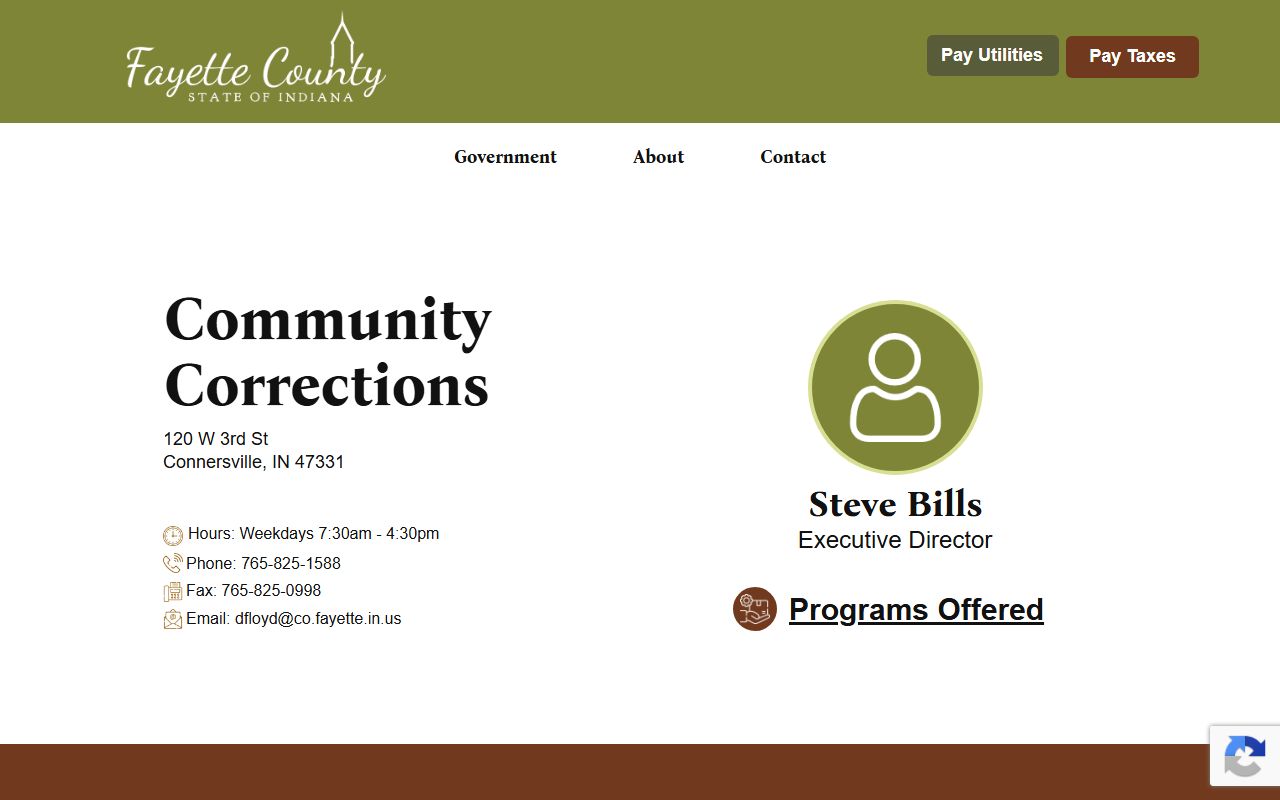
Because the program serves more than one status group, searchers should avoid one-size-fits-all assumptions. A jailed person belongs in the county jail search. A sentenced state prisoner belongs in the IDOC locator. A local work-release or home-detention participant may require direct contact with Community Corrections or the court that ordered supervision.
Fayette Community Corrections Data
The research did not locate a building capacity for Fayette County Community Corrections. The strongest number is from the Indiana Department of Correction May 2025 Offender Population Report. That report lists Fayette County of commitment with 133 in DOC, 92 in Community Corrections, 9 in Jail DOC, 1 Jail Felony F6 Diversion, and a county total of 235. Those are county-of-commitment correctional categories, not a headcount inside the West 3rd Street office or residential work-release beds.
This caveat is important. A person counted in Community Corrections may be in residential work release, home detention, electronic monitoring, CTP, day reporting, or another ordered program status. The number does not mean 92 people are housed in one building, and it does not prove that each participant has an INjail profile. The jail roster is built for county jail custody, while the Community Corrections count reflects a broader correctional category.
| Category | Figure | How to Read It |
|---|---|---|
| DOC | 133 | County-of-commitment count in IDOC's May 2025 report. |
| Community Corrections | 92 | Program category, not building occupancy. |
| Jail DOC | 9 | IDOC-linked jail category in the county-of-commitment table. |
| Jail Felony F6 Diversions | 1 | Diversion category from the same IDOC report. |
Find Community Corrections Status
There is no research finding that every Fayette County Community Corrections participant appears in INjail. Use the person's status to choose the correct channel. If the person was just arrested or is physically in Fayette County Jail, search the county jail roster. If the person has been sentenced to IDOC or is in a Community Transition Program path from prison, use the Indiana Department of Correction locator to check the DOC number and current facility assignment. For local program status, contact Fayette County Community Corrections during office hours.
- Decide whether the person is in jail custody, state prison custody, or local community supervision.
- For jail custody, search INjail by name, county, and booking date, then confirm the facility shown on the result.
- For state-prison or CTP status, search IDOC by last name or first and last name when known.
- For work release, home detention, day reporting, or electronic monitoring, call Community Corrections and ask what information can be confirmed.
- For court-ordered status, check MyCase and the clerk or court for official case entries.
Community Corrections is often connected to court orders, release conditions, sentence modifications, or IDOC transition status. That means a public record may be split across several systems. INjail may answer whether someone is in jail; IDOC may answer whether someone remains in state custody; the local program office may answer program-contact questions; the court file may show the order that placed the person into supervision.
Fayette Community Corrections Contact
The official county page gives weekday office hours and direct contact details for Fayette County Community Corrections. Use these contacts for program questions, public counter needs, confirmation of what the office can disclose, and questions about reporting requirements. Do not use the Community Corrections office as a substitute for emergency custody confirmation at the jail.
Fayette County Community Corrections
120 W 3rd St
Connersville, IN 47331
765-825-1588
Weekdays 7:30 am to 4:30 pm
Fax: 765-825-0998
Email: dfloyd@co.fayette.in.us
Program Leadership
Steve Bills, Executive Director
Alana Friend, Assistant Director
Eric Cantrell, Facility Supervisor
Lisa Phillips, Case Manager, CTP, CSR Supervisor
Program Visits and Reporting
Fayette County Community Corrections should not be treated like a jail visitation site. The official page publishes office hours and program categories, but it does not publish a public visiting schedule for residential work release participants, a video visitation vendor, visitor ID rules, or a family-visit calendar. A participant's reporting, movement, and contact rules may come from the court, the program, IDOC CTP rules, or a supervision agreement.
| Topic | Published Detail | Correct Next Step |
|---|---|---|
| Office hours | Weekdays 7:30 am to 4:30 pm | Use the public counter for program contact. |
| Jail visitation | Not applicable | Use Fayette County Jail for jail custody and jail visits. |
| Work-release contact rules | Not published in the located source | Ask Community Corrections for current participant rules. |
| CTP or IDOC-linked contact | May involve state custody status | Check IDOC and the local program before relying on one source. |
Note: Call Fayette County Community Corrections before visiting the office for participant-specific questions or program documents.
Mail, Fees, and Program Costs
The research did not locate a Fayette County Community Corrections fee schedule, residential work-release rent schedule, electronic-monitoring fee, drug-test fee, commissary system, phone vendor, or mail rule. It also did not locate a public list of what may be sent to a participant. Do not import jail commissary or phone assumptions into this page. Community Corrections supervision is usually governed by program rules and court orders, and the public county page does not give enough detail to publish dollar amounts.
| Service or Cost | Official Finding | How to Verify |
|---|---|---|
| Residential work-release fees | Not published in located source | Ask Community Corrections directly. |
| Electronic monitoring costs | Not published | Confirm with program staff or the court order. |
| Mail to participants | Not published | Ask whether mail is allowed and what format is required. |
| Commissary | No county source located | Do not assume a jail commissary applies. |
Program Intake and Supervision
Community Corrections intake is different from jail booking. A jail booking follows an arrest and creates a jail custody record. Community Corrections intake may follow a court order, pretrial diversion placement, work-release approval, home-detention order, electronic-monitoring setup, day-reporting requirement, or IDOC transition. The official program list also includes cognitive, social, behavioral, and addiction classes, including Thinking for a Change, Living in Balance, Anger Management, and GED/TASC.
For a person moving from arrest to local supervision, a useful records path is custody first, then court, then program. Search the jail if the person may still be booked. Check court records for the order or condition that created the program placement. Contact Community Corrections for current reporting instructions, allowed contact, or program-office requirements. The Fayette County jail inmate records path is still useful when a person began in jail custody, but it is not a complete Community Corrections roster.
About Fayette County Programs
Fayette County Community Corrections is one block or area away from the county jail in downtown Connersville, but its role is separate. The jail and sheriff are at 123 W 4th St. Community Corrections is at 120 W 3rd St. The courthouse offices for the clerk, prosecutor, and superior court are at 401 N Central Ave. Those close addresses can confuse families and records users, especially when a person moves from jail booking to court conditions and then to local supervision.
The staff list gives the program a strong local footprint. In addition to leadership, the research identifies Kari Ruff and Amber Blaes as case managers, Joe Oliver, Brian Hamilton, Madison Fields, and William Harrison as field or treatment staff, and Jana Sparks as Community Corrections / Probation Liaison. William Harrison is listed as Jail Treatment Facilitator, a detail that connects jail treatment work with the broader local reentry structure without making Community Corrections a jail.
Note: Community Corrections status can change through court, IDOC, or program action, so verify with the office tied to the record.