
Fayette County Court Records After Arrest
The Fayette County arrest-to-court path starts with booking at the Fayette County Jail and then moves to prosecutor review. The Fayette County Prosecutor decides what formal charges to file, and those filed charges become part of the court record. Jail charges can be a useful lead, but they are not always the final filed charges. Prosecutor-filed charges may be amended, reduced, dismissed, or replaced as facts and legal review develop.
Custody and court records answer different questions. The Fayette County jail inmate records path is for current or recent custody, booking number, arrest date, holds, and release status. The court-record path is for the criminal case itself, including filed charges, hearings, bond orders, warrants that appear on the docket, and disposition. Booking photos are a separate roster issue covered by Fayette County jail mugshots.
Search MyCase After Fayette Arrest
The official case-search route is Indiana MyCase, with local court routing also available from the Indiana Judicial Branch Fayette County page. MyCase can show case information and some documents, but official records of proceedings and copies of documents should be requested from the court or clerk that maintains the file. For Fayette County, the clerk and court offices are at the courthouse, not at the jail.
- Open MyCase and search by case number if it is known.
- If no case number is known, search by party name and use Fayette County or court filters when available.
- Open the criminal or infraction case that matches the defendant, date range, and court.
- Read each charge entry for offense name, statute or code, severity level, and current status.
- Review the chronological case summary for hearings, bond orders, warrant events, filings, and disposition.
The official MyCase portal is the main public search point for Indiana court records after a jail arrest.
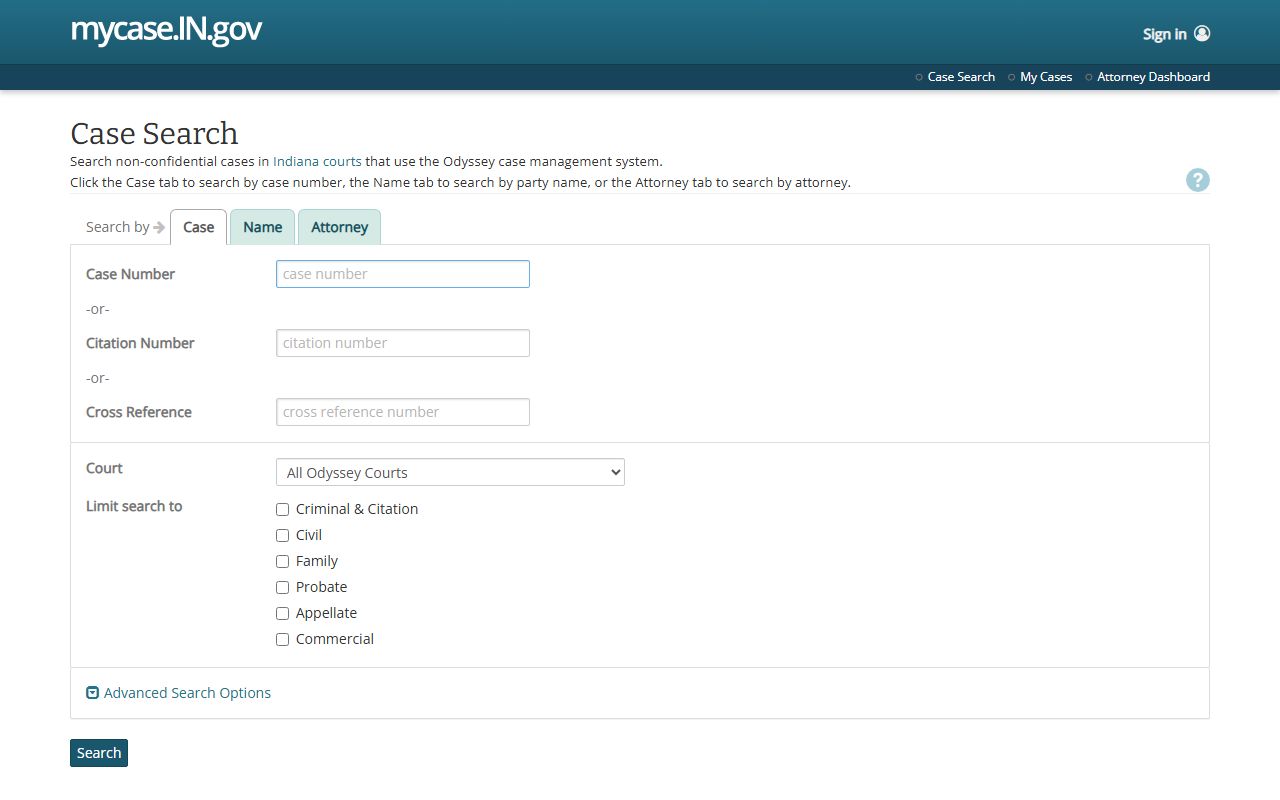
The MyCase search screen is separate from INjail, which is why a Fayette County arrest should be checked in both custody records and court records when charges have been filed.
| Field or Mode | Type | Required | Notes |
|---|---|---|---|
| Case number | Text | Optional | Best for exact case lookup when the number is known. |
| Party name | Text | Optional | Use defendant name; spelling variations can matter. |
| Attorney | Text | Optional | Useful when checking attorney-linked cases. |
| Court or county filters | Dropdown/filter | Optional | Use Fayette County when available. |
| Case type | Filter | Optional | Criminal, infraction, civil, and other types may appear. |
Fayette County Charging Documents
Formal court records after a jail arrest usually begin with a charging document. Indiana criminal cases may use a complaint, information, or indictment depending on the route and charge type. The charging document is where the accusation becomes a court filing. It should be read with the case docket because later entries may amend, dismiss, or resolve the charge.
| Document | Filed By | Common Use | Why It Matters |
|---|---|---|---|
| Complaint | Officer or prosecutor | Often used early in misdemeanor or probable-cause filings. | Can start the case after arrest. |
| Information | Prosecutor | Common route for prosecutor-filed criminal charges. | States the formal charge the State intends to pursue. |
| Indictment | Grand jury | Used in cases that follow a grand-jury path. | Shows the grand jury accusation that starts or supports prosecution. |
Indiana uses county prosecutors rather than a local district attorney title. The official Fayette County Prosecutor page lists Bette Jones as prosecutor and places the office at the courthouse. That office reviews arrest facts and decides the filed charge path, while the clerk and court maintain the official case record.
Fayette County Charge Status
Charge status changes are common. A booking charge on a jail profile may be based on the arresting agency's initial entry, while the filed court charge reflects prosecutor review. A court record after arrest should be read by status, not just by the first charge name that appears. Pending means unresolved. Dismissed means that charge is no longer being prosecuted in that case. Amended or reduced means the filed accusation changed.
| Status | What It Means | Reader Caution |
|---|---|---|
| Pending | The charge is open and not yet resolved. | Do not treat it as a conviction. |
| Amended | The charge text, level, or statute was changed by later filing. | Check the most recent docket entry. |
| Reduced | The charge level or offense was lowered. | Read the disposition, not only the original filing. |
| Dismissed | The charge was ended by court order or prosecutor action. | Other counts in the same case may remain. |
| Disposed | The charge reached a plea, judgment, dismissal, or other final action. | Review sentence and judgment entries. |
Bond Orders and Court Payments
Bond sits between jail custody and court authority. The jail may show bond data as a custody snapshot, but the court order controls formal bond status. The Fayette County Clerk page specifically lists receipt of payments for bond, criminal restitution, criminal case filing fees, and other court payments. The jail or sheriff should still be contacted first to confirm custody, holds, and release process before a payment is attempted.
| Bond Type | How It Works | Local Checkpoint |
|---|---|---|
| Cash bond | Money is paid directly to secure release. | Confirm payment process with jail and clerk. |
| Surety bond | A licensed bail agent posts the bond. | Confirm whether any hold blocks release. |
| Personal recognizance | Release on promise and conditions instead of full payment. | Check the court order in MyCase. |
| Property bond | Property is pledged if allowed by the court. | Ask the clerk about accepted procedure. |
| No-bond hold | Ordinary payment will not release the person. | Look for court, probation, parole, federal, ICE, or out-of-county holds. |
Fayette Court and Prosecutor Contacts
The local court-record offices are separate from the jail. The clerk is the official contact for many court-file and payment functions, the prosecutor handles filed criminal charges, and the court controls hearings and orders. MyCase is useful for search, but the local office that maintains the record is the source for official copies or document questions.
Fayette County Clerk
401 N Central Ave, 2nd Floor North End
Connersville, IN 47331
765-825-1813
Bond and criminal payment receipt functions are listed by the clerk.
Fayette County Prosecutor
401 N Central Ave, 1st Floor
Connersville, IN 47331
765-825-3251
Reviews arrests and files formal criminal charges.
Fayette County Superior Court
401 N Central Ave
Connersville, IN 47331
765-825-1331
Jurisdiction includes criminal misdemeanors, traffic-related felonies, traffic, and ordinance matters.
Warrants After Fayette County Arrest
No official Fayette County active warrant search page was located in the research sweep. INjail may show holds after a person is booked, but it is not a pre-arrest warrant index. MyCase can show warrant events when they are docketed in a case. For active warrant questions, use official sheriff, clerk, court, or prosecutor channels and avoid third-party warrant lists that are not tied to Fayette County government.
- Arrest warrant
- A court order authorizing law enforcement to take a person into custody.
- Bench warrant
- A court-issued warrant, often tied to failure to appear or failure to comply.
- Detainer or hold
- A request or authority that may keep a person in jail for another agency or court.
- Probation or parole hold
- A supervision hold that can block release even when local bond appears payable.
Charges vs Convictions
A charge is an accusation. A conviction is the result of a plea, verdict, or judgment. Fayette County court records after a jail arrest can contain both, but they are not the same legal event. The docket should be checked for disposition before any conclusion is drawn from a charge line.
| Point | Charge | Conviction |
|---|---|---|
| Stage | Filed accusation after arrest review. | Resolved finding by plea or judgment. |
| Proof level | Based on probable cause or charging standard. | Requires plea or proof beyond a reasonable doubt. |
| Record meaning | Shows what was alleged. | Shows the case outcome. |
| Can change | May be amended, reduced, or dismissed. | May later be affected by appeal, sentence modification, sealing, or expungement. |
Sealed and Expunged Records
Indiana expungement and sealing references appear under IC 35-38-9 in the official Indiana Code. Jail roster removal is not the same thing as court expungement. A person can leave the public jail roster after release or transfer while the court case remains searchable. Conversely, a court case may become sealed or restricted while separate agency records still require an official request and review.
| Issue | Sealed | Expunged |
|---|---|---|
| Public view | Hidden or restricted from ordinary public access. | Restricted under the expungement order and statute. |
| Record source | Usually handled through the court record. | Requires eligibility and court action under Indiana law. |
| Jail roster effect | Does not automatically explain every online custody display. | Not the same as routine release from the roster. |
| Best source | Clerk or court that maintains the case. | Clerk, court, and legal counsel for eligibility questions. |
Important: Public court data may not be used for employment, credit, tenant screening, insurance, or other FCRA-regulated decisions from this source.